
6 Frameworks Every Aspiring Product Manager Needs to Crack Any PM Case
Because “Let me think about this for a moment” only buys you 30 seconds.


The Problem With PM Interviews
Here’s the dirty secret about PM interviews - They don’t test how smart you are. They test whether you can think out loud in a structure that makes sense.
The candidate who says “I’d improve Instagram by adding dark mode” loses to the candidate who says “Before jumping to solutions, let me first understand the objective - are we optimizing for retention, engagement, conversion, or satisfaction?”
Same intelligence. Different outcome. The difference? Frameworks.
Not frameworks you memorize and regurgitate. Frameworks that wire your brain to ask the right questions in the right order - so even under pressure, you sound like someone who’s shipped products before.
Today, we’re sharing 6 decision trees we’ve refined over the years. Each one maps to a specific type of PM case you’ll face. Print them. Internalize them. Make them yours.
Why Decision Trees Beat Memorized Frameworks
Most PM prep content gives you frameworks like CIRCLES, RICE, or the classic “clarify → structure → solve → summarize” approach. These are fine. They’re also what every other candidate is using.
Decision trees are different. They’re exhaustive question maps that ensure you don’t miss critical angles. They help you -
Avoid the “I forgot to ask about...” moment that hits you in the elevator after
Sound senior by naturally covering edge cases interviewers were hoping you’d catch
Stay calm under pressure because you have a mental checklist, not just vibes
Think of these as your private cheat codes. The interviewer sees structured thinking. You see a map you’ve walked before.
The 6 Case Types (And Their Decision Trees)
1. Product Strategy
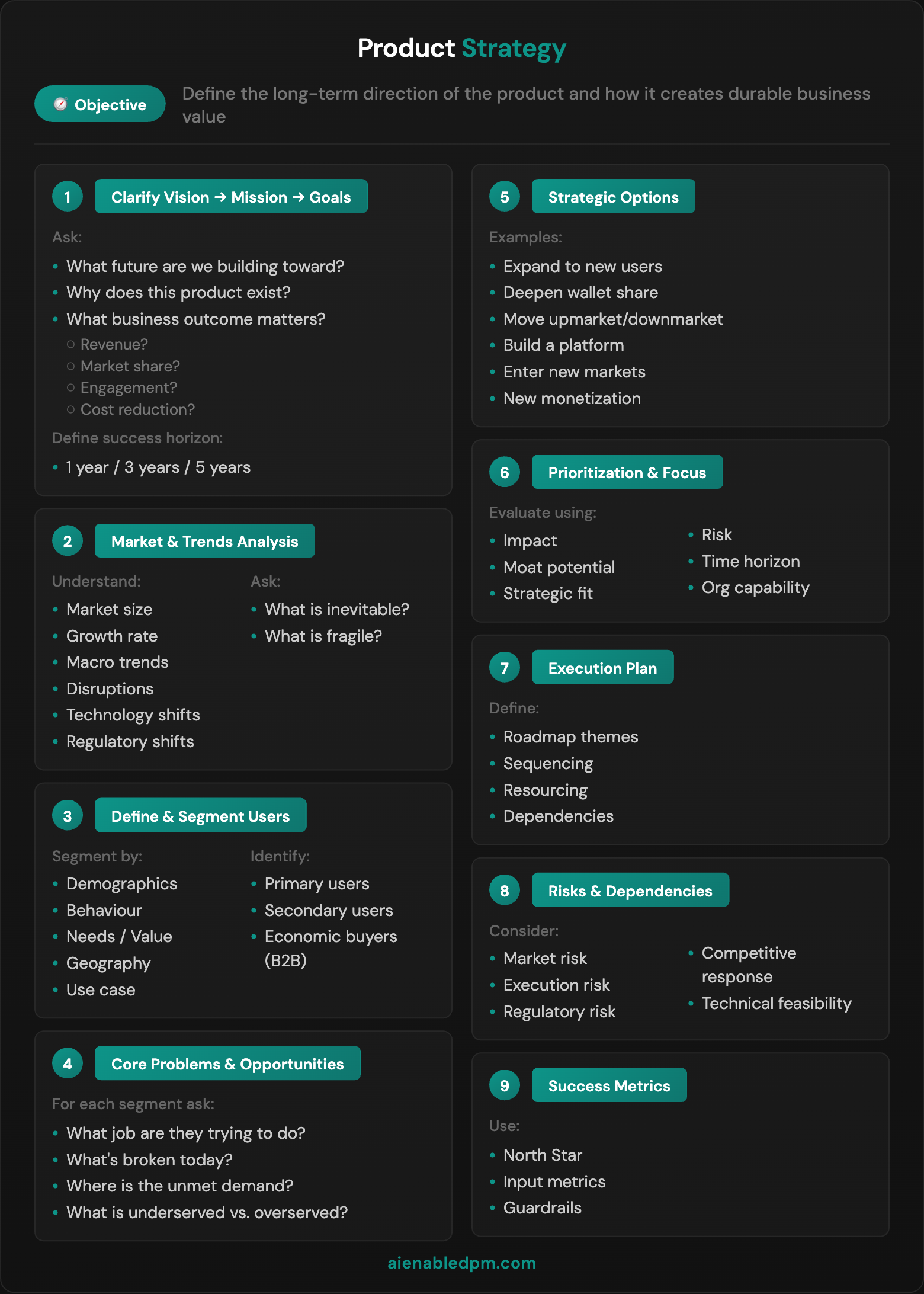
The Case Type: “What Should Our Product Strategy Be?”
This is the big-picture case. You’re asked to define direction, not features. It tests whether you can zoom out and think about durable competitive advantage.
The Decision Tree:
Step 1: Clarify Vision → Mission → Goals Start by anchoring on the “why.” Ask - What future are we building toward? Why does this product exist? What business outcome matters - revenue, market share, engagement, or cost reduction? Then define success horizons - what does good look like at 1 year, 3 years, and 5 years? A vision without a timeline is fantasy. A goal without a vision is a task.
Step 2: Market & Trends Analysis Before you strategize, understand the playing field. Map market size, growth rate, macro trends, disruptions, technology shifts, and regulatory shifts. Then ask two critical questions - What is inevitable? (Bet on it.) What is fragile? (Don’t depend on it.) The best strategies ride tailwinds and avoid building on shaky ground.
Step 3: Define & Segment Users Segment users by demographics, behavior, needs/value, geography, and use case. Then identify who matters most - primary users (your core), secondary users (adjacent), and economic buyers (especially in B2B, where the user and buyer are often different). Trying to serve everyone means serving no one well.
Step 4: Core Problems & Opportunities For each segment, ask - What job are they trying to do? What’s broken today? Where is the unmet demand? What is underserved vs. overserved? The best opportunities live at the intersection of painful, frequent, and underserved.
Step 5: Strategic Options Now generate your menu of moves. Common options include: expand to new users, deepen wallet share with existing users, move upmarket or downmarket, build a platform, enter new markets, or explore new monetization models. Don’t commit yet - just map the possibilities.
Step 6: Prioritization & Focus Evaluate each option using - impact, moat potential, strategic fit, risk, time horizon, and org capability. Strategy is as much about what you say “no” to as what you say “yes” to. The discipline is in the trade-offs.
Step 7: Execution Plan Translate strategy into action. Define roadmap themes (not features), sequencing (what unlocks what), resourcing, and dependencies. A strategy without an execution plan is a PowerPoint. An execution plan without a strategy is busy work.
Step 8: Risks & Dependencies Pressure-test your plan. Consider market risk (will demand materialize?), execution risk (can we build it?), regulatory risk (will rules change?), competitive response (how will rivals react?), and technical feasibility (is this even possible?). Name the risks before they name themselves.
Step 9: Success Metrics Define how you’ll know it’s working. Establish a North Star metric (the one number that matters most), input metrics (leading indicators you can act on), and guardrails (lines you won’t cross). If you can’t measure it, you can’t manage it.
When You’ll See This - Senior PM roles. Strategy-focused companies. Any “how would you approach the next 2 years” question.
2. Product Design
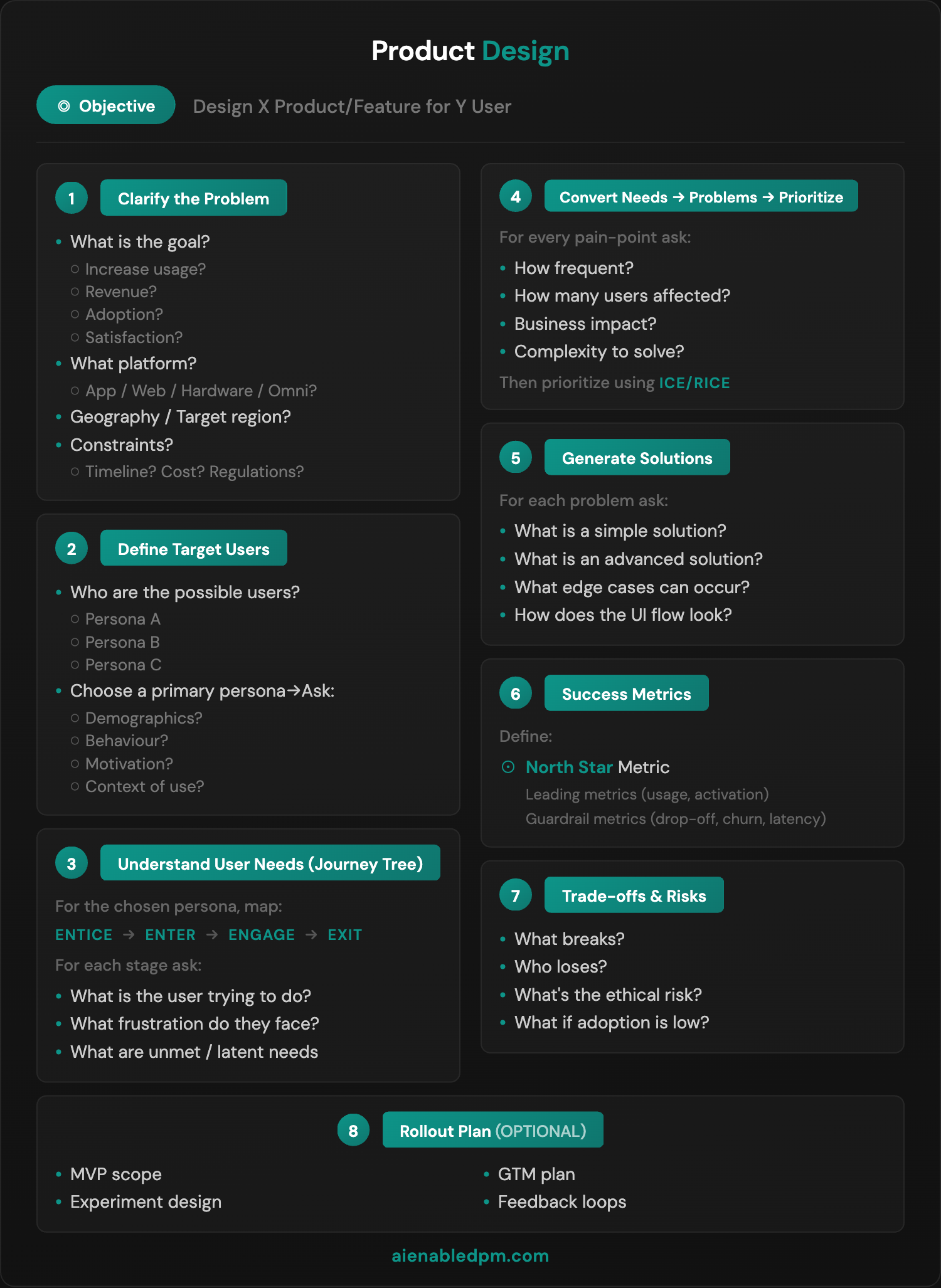
The Case Type: “Design [X Product] for [Y User]”
This case tests your ability to go from zero to a clear product concept - user-centered, scoped, and practical.
The Decision Tree:
Step 1: Clarify the Problem What is the goal - increase usage, revenue, adoption, or satisfaction? What platform - app, web, hardware, omnichannel? What geography or target region? What constraints - timeline, cost, regulations?
Step 2: Define Target Users Who are the possible users? Define multiple personas. Choose a primary persona. For them, ask - Demographics? Behavior? Motivation? Context of use?
Step 3: Understand User Needs (Journey Tree) For the chosen persona, map the journey - Entice → Enter → Engage → Exit. For each stage, ask - What is the user trying to do? What frustration do they face? What are unmet or latent needs?
Step 4: Convert Needs → Problems → Prioritize For every pain point, ask - How frequent? How many users affected? What’s the business impact? How complex to solve? Then prioritize using ICE or RICE.
Step 5: Generate Solutions For each problem, ask - What is a simple solution? What is an advanced solution? What edge cases can occur? How does the UI flow look?
Step 6: Success Metrics Define your North Star metric, leading metrics (usage, activation), and guardrail metrics (drop-off, churn, latency).
Step 7: Trade-offs & Risks Ask - What breaks? Who loses? What’s the ethical risk? What if adoption is low?
Step 8: Rollout Plan (Optional) Define MVP scope, experiment design, GTM plan, and feedback loops.
When You’ll See This - Product design cases at Google, Meta, and most consumer companies.
3. Pricing & Monetization
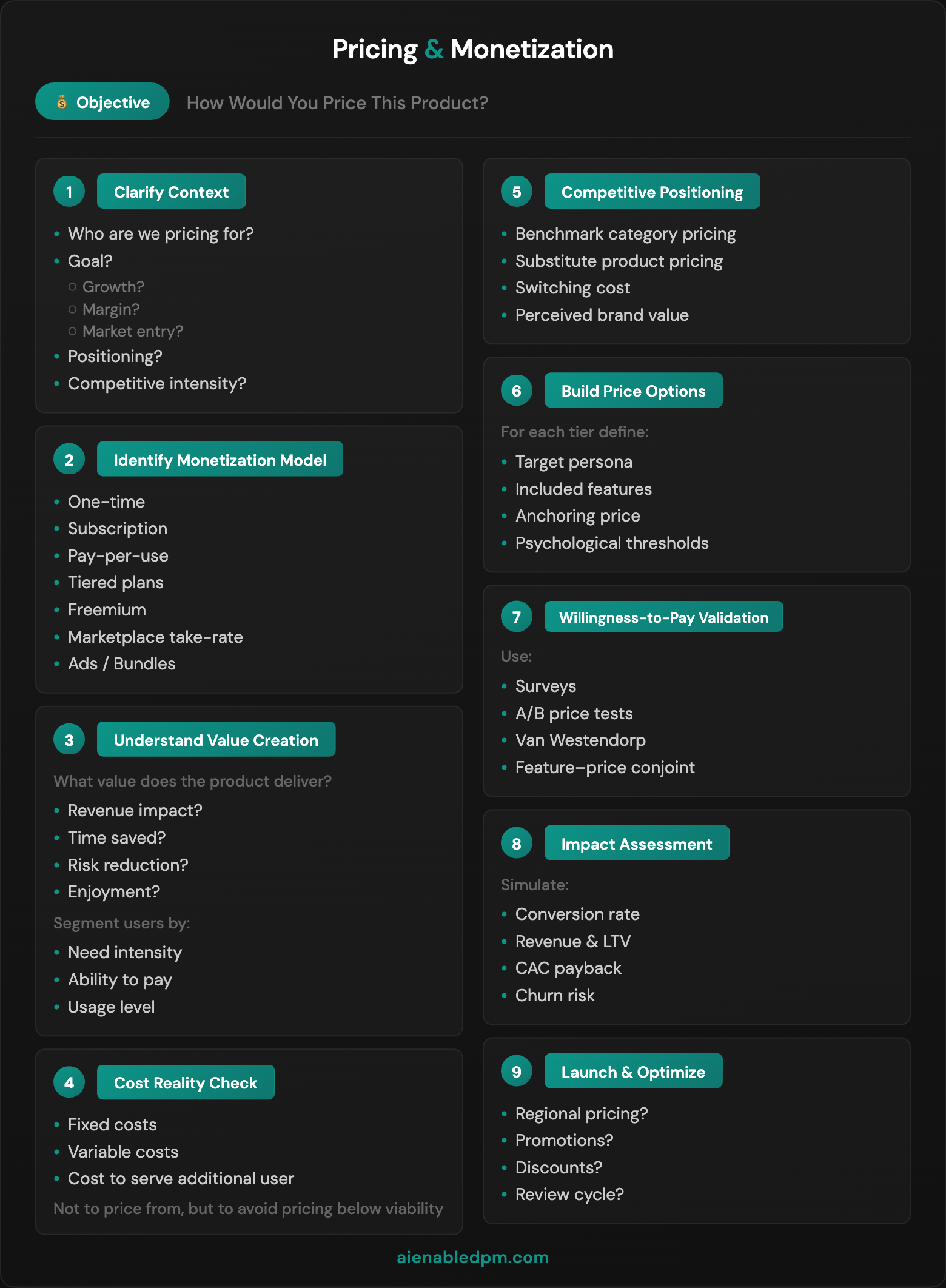
The Case Type: “How Would You Price This Product?”
This case tests whether you understand that pricing is strategy, not arithmetic. It’s about value capture, positioning, and market dynamics.
The Decision Tree:
Step 1: Clarify Context Ask - Who are we pricing for? What’s the goal - growth, margin, or market entry? What’s our positioning? How intense is competition?
Step 2: Identify Monetization Model Consider options - one-time purchase, subscription, pay-per-use, tiered plans, freemium, marketplace take-rate, ads, or bundles. Each model implies different user relationships.
Step 3: Understand Value Creation What value does the product deliver? Revenue impact? Time saved? Risk reduction? Enjoyment? Segment users by need intensity, ability to pay, and usage level.
Step 4: Cost Reality Check Map fixed costs, variable costs, and cost to serve each additional user. This isn’t to price from - it’s to avoid pricing below viability.
Step 5: Competitive Positioning Benchmark category pricing and substitute product pricing. Assess switching costs and perceived brand value.
Step 6: Build Price Options For each tier, define - target persona, included features, anchoring price, and psychological thresholds.
Step 7: Willingness-to-Pay Validation Use surveys, A/B price tests, Van Westendorp analysis, or feature-price conjoint studies.
Step 8: Impact Assessment Simulate conversion rate, revenue and LTV, CAC payback, and churn risk.
Step 9: Launch & Optimize Consider regional pricing, promotions, discounts, and review cycles.
When You’ll See This - B2B product roles, marketplace companies, any monetization discussion.
4. Go-To-Market (GTM) Strategy
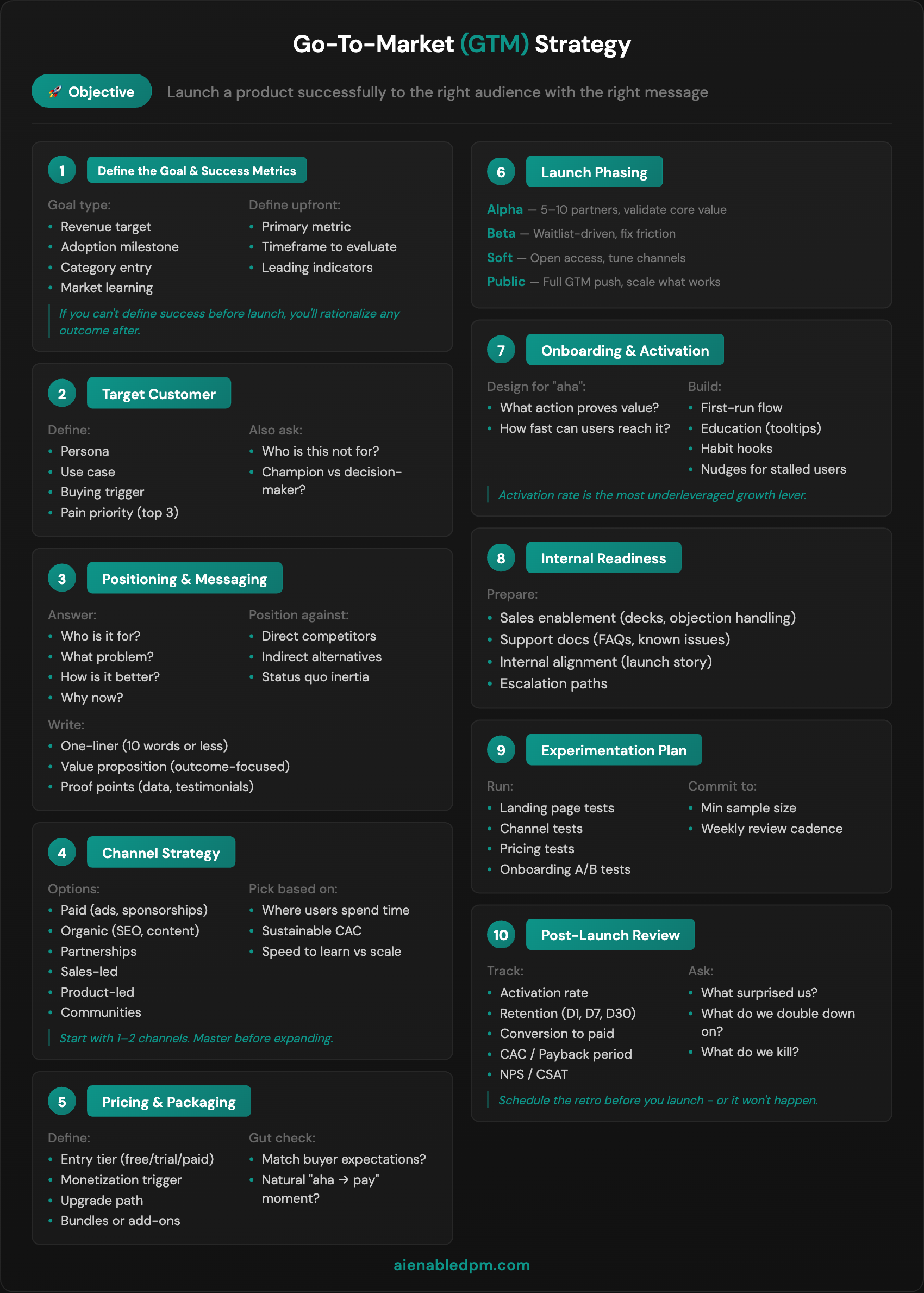
The Case Type: “How Would You Take This Product to Market?”
This case tests whether you can launch a product successfully - right audience, right message, right channels.
The Decision Tree:
Step 1: Define Goal & Success Metrics What’s the goal type - revenue target, adoption milestone, category entry, or market learning? Define upfront - primary metric, timeframe to evaluate, and leading indicators. If you can’t define success before launch, you’ll rationalize any outcome after.
Step 2: Target Customer Define persona, use case, buying trigger, and top 3 pain priorities. Also ask - Who is this NOT for? Is the user the champion or the decision-maker?
Step 3: Positioning & Messaging Answer - Who is it for? What problem does it solve? How is it better? Why now? Position against direct competitors, indirect alternatives, and status quo inertia. Write - a one-liner (10 words or less), value proposition (outcome-focused), and proof points (data, testimonials).
Step 4: Channel Strategy Options include paid (ads, sponsorships), organic (SEO, content), partnerships, sales-led, product-led, and communities. Pick based on where users spend time, sustainable CAC, and speed to learn vs. scale. Start with 1-2 channels. Master before expanding.
Step 5: Pricing & Packaging Define entry tier (free/trial/paid), monetization trigger, upgrade path, and bundles or add-ons. Gut check - Does this match buyer expectations? Is there a natural “aha → pay” moment?
Step 6: Launch Phasing Alpha - 5-10 partners, validate core value. Beta - Waitlist-driven, fix friction. Soft launch - Open access, tune channels. Public - Full GTM push, scale what works.
Step 7: Onboarding & Activation Design for “aha” - What action proves value? How fast can users reach it? Build - first-run flow, education (tooltips), habit hooks, and nudges for stalled users. Activation rate is the most underleveraged growth lever.
Step 8: Internal Readiness Prepare sales enablement (decks, objection handling), support docs (FAQs, known issues), internal alignment (launch story), and escalation paths.
Step 9: Experimentation Plan Run landing page tests, channel tests, pricing tests, and onboarding A/B tests. Commit to minimum sample size and weekly review cadence.
Step 10: Post-Launch Review Track activation rate, retention (D1, D7, D30), conversion to paid, CAC and payback period, and NPS/CSAT. Ask - What surprised us? What do we double down on? What do we kill? Schedule the retro before you launch - or it won’t happen.
When You’ll See This - Any product launch discussion, growth roles, marketing PM positions.
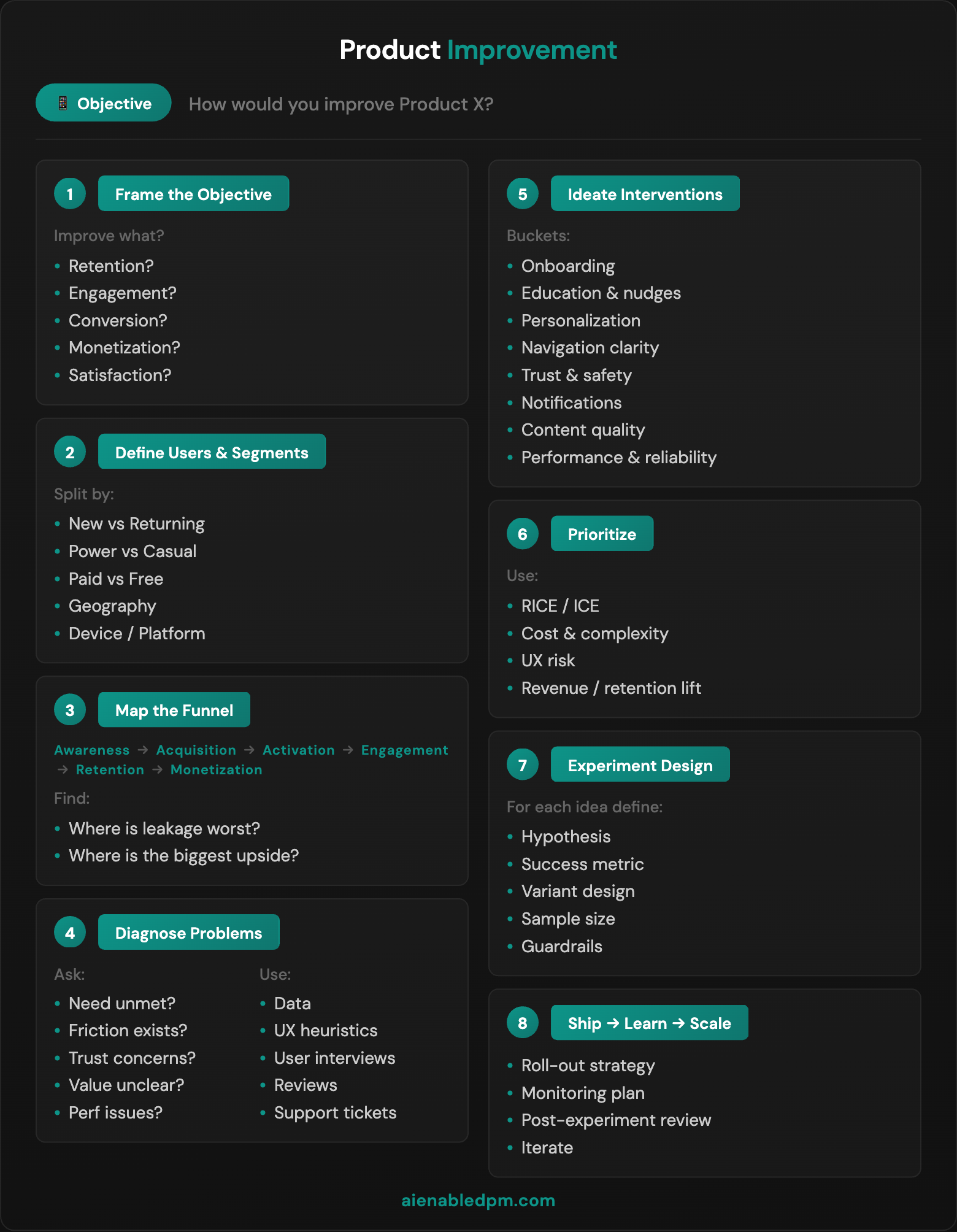
5. Product Improvement
The Case Type: “How Would You Improve [Product X]?”
The most common PM interview question. Deceptively simple. Most candidates jump to features. Winners diagnose first.
The Decision Tree:
Step 1: Frame the Objective Improve what? Retention? Engagement? Conversion? Monetization? Satisfaction? Get specific.
Step 2: Define Users & Segments Split by - new vs. returning, power vs. casual, paid vs. free, geography, device/platform.
Step 3: Map the Funnel Trace - Awareness → Acquisition → Activation → Engagement → Retention → Monetization. Find - Where is leakage worst? Where is the biggest upside?
Step 4: Diagnose Problems Ask - Is there an unmet need? Does friction exist? Are there trust concerns? Is value unclear? Are there performance issues? Use - data, UX heuristics, user interviews, reviews, and support tickets.
Step 5: Ideate Interventions Generate ideas across buckets - Onboarding, education & nudges, personalization, navigation clarity, trust & safety, notifications, content quality, performance & reliability.
Step 6: Prioritize Use RICE or ICE scoring. Consider cost & complexity, UX risk, and revenue/retention lift.
Step 7: Experiment Design For each idea, define - hypothesis, success metric, variant design, sample size, and guardrails.
Step 8: Ship → Learn → Scale Plan roll-out strategy, monitoring, post-experiment review, and iteration.
When You’ll See This - Almost every PM interview. The most common case type across all companies.
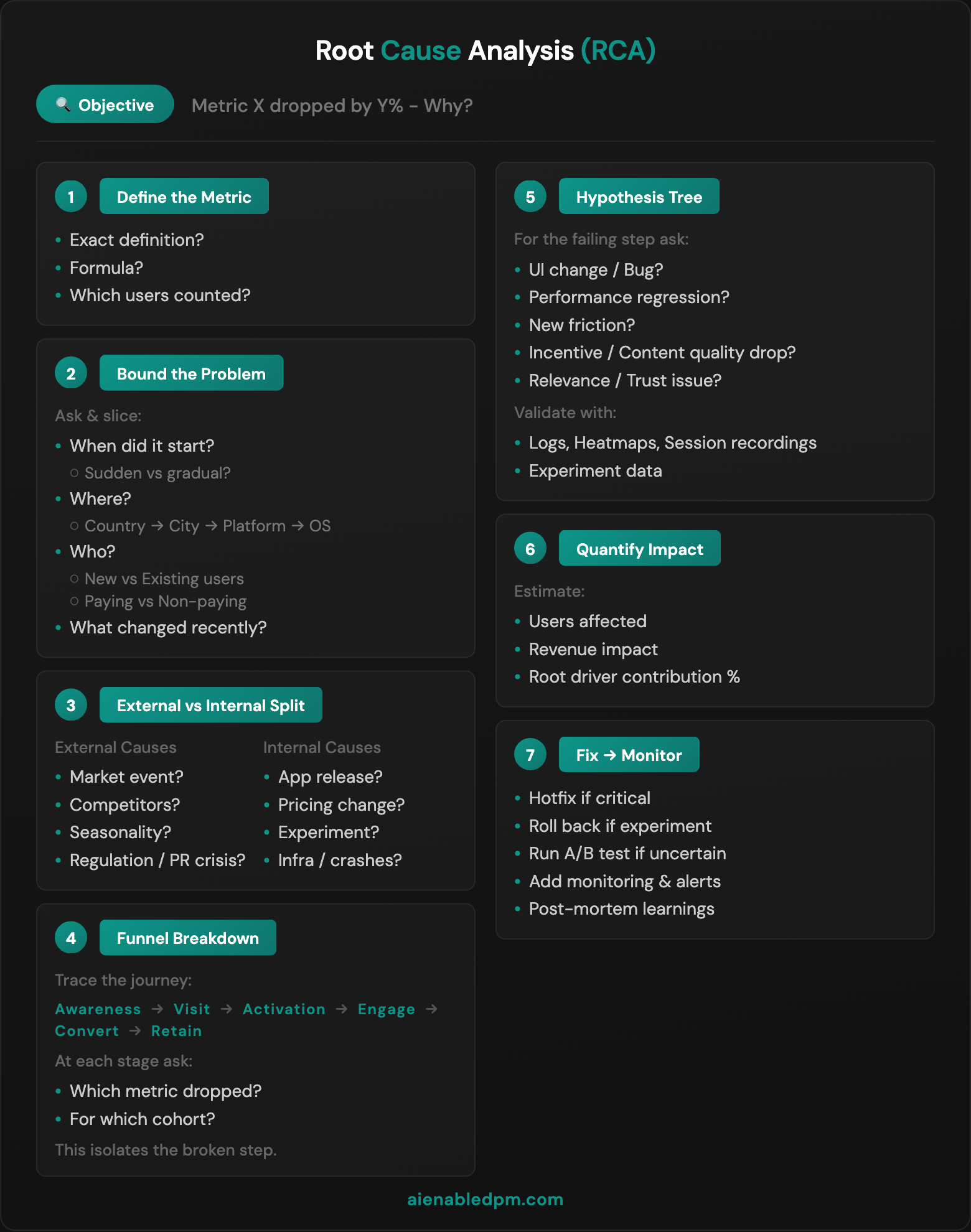
6. Root Cause Analysis (RCA)
The Case Type: “Metric X Dropped by Y% - Why?”
This is the diagnostic case. Something broke. Revenue is down 15%. DAU dropped 20%. Conversion tanked. Your job - find out why without spiraling into guesswork.
The Decision Tree:
Step 1: Define the Metric Start by making sure you understand what you’re measuring. Ask about the exact definition, the formula behind it, and which users are counted. A “DAU drop” means different things if it includes bots vs. verified users.
Step 2: Bound the Problem Slice the data - When did it start? Was it sudden or gradual? Where is it happening - specific country, city, platform, OS? Who is affected- new vs. existing users, paying vs. free? What changed recently?
Step 3: External vs. Internal Split Categorize potential causes. External causes include market events, competitor moves, seasonality, or regulatory/PR issues. Internal causes include app releases, pricing changes, experiments, or infrastructure problems.
Step 4: Funnel Breakdown Trace the user journey: Awareness → Visit → Activation → Engage → Convert → Retain. At each stage, ask - Which metric dropped? For which cohort? This isolates the broken step.
Step 5: Hypothesis Tree For the failing step, build hypotheses - UI change or bug? Performance regression? New friction? Incentive or content quality drop? Relevance or trust issue? Validate with logs, heatmaps, session recordings, and experiment data.
Step 6: Quantify Impact Estimate users affected, revenue impact, and the contribution percentage of the root driver.
Step 7: Fix → Monitor Deploy hotfix if critical, roll back if experimental, run A/B test if uncertain. Add monitoring and alerts. Document post-mortem learnings.
When You’ll See This - Any “explain this metric change” question. Common at data-heavy companies like Meta, Uber, and Stripe.
How to Use These Templates
Before the interview:
Print each decision tree (or keep them on your phone)
Practice one case type per day
Time yourself - most cases are 35-45 minutes
Record yourself and listen back for clarity gaps
During the interview:
Ask clarifying questions (Step 1 of every template)
State your structure out loud before diving in
Check in with the interviewer at each step
It’s okay to skip steps if time is short - tell them why
The meta-skill - These templates aren’t scripts. They’re checklists. The goal is to internalize the thinking pattern so deeply that you don’t need to consciously recall them - they just flow.
Final Thoughts & Placement Season Wisdom
The uncomfortable truth - PM interviews favor people who sound like PMs. These templates help you sound like a PM. Use them until you become one.
A few parting thoughts as you head into interview season:
“I don’t know” is better than “Let me BS my way through this.” Interviewers respect intellectual honesty.
Silence is thinking time, not awkward time. Take 30 seconds to structure your thoughts. It shows discipline, not weakness.
Write as you talk. Ask if you can use the whiteboard/paper. Visual structure is easier to follow than verbal gymnastics.
Every rejection is data. Ask for feedback. Iterate your answers. The person who does 30 mock cases will outperform the genius who did 5.
Be human. Interviewers hire people they want to work with. Technical competence gets you to the final round. Likability gets you the offer.
Now go land that PM role. These frameworks have your back.
Found this useful? Share it with someone grinding through PM prep. We’re all in this together.
Until next time.