
Upskill or Get Abstracted
What the AI era actually demands from product managers


The Thesis: The moat has moved. Are you upstream of it?
Every PM we know is experimenting with AI. But experimenting isn’t upskilling. And tool fluency isn’t the same as judgment fluency.
Here’s the uncomfortable truth: AI hasn’t made the PM job easier — it’s raised the floor and collapsed the middle. The PMs who wrote decent PRDs, ran passable discovery sessions, and shipped on reasonable timelines? That work is being absorbed. Not by AI alone, but by leaner teams wielding AI.
The question is no longer “are you using AI?” It’s “what does your contribution look like when execution is nearly free?” When a junior PM with Claude and Cursor can prototype a feature in a weekend, your value can’t live at the execution layer. It has to live upstream — in the quality of the problem you chose, the reasoning behind the call, and the judgment you brought before the first line of code was written.
“Execution is becoming a commodity. The durable moat is the quality of decisions you make before execution begins.”
This isn’t a crisis. It’s a clarification. The AI era is forcing PM work to become what it always should have been: a high-judgment, high-context discipline. The upskilling challenge isn’t learning more tools — it’s developing a fundamentally different relationship with your own thinking.
The Skills Restack: What to learn, deepen, and let go
Decision documentation
Capturing not just what you decided, but why — the constraints, the tradeoffs, the confidence level. AI can execute; it can’t reconstruct the context you held.
Learn
Prompt architecture
Treating prompts as product specs. Structuring AI inputs with the same rigor you’d apply to an engineering requirement. This is now a core PM skill.
Deepen
Shallow PRD writing
Writing documents that describe what to build without capturing why. AI will soon draft better shallow PRDs than most humans. That’s not where PM value lives.
Let go
AI-in-the-loop discovery
Running synthesis and pattern recognition through AI during user research — freeing you to focus on the anomalies, the edge cases, the signals that break the pattern.
Learn
Systems thinking
Understanding how AI components fit into your product architecture — not as an engineer, but as someone who can ask the right questions about dependencies, failure modes, and leverage points.
Deepen
Status update theater
The rituals of PM visibility — slide decks summarizing sprints, meeting-heavy roadmap reviews — are exactly what AI will automate first. Confusing visibility with value is a trap.
Let go
The Learning Stack: A practical upskilling architecture
We get asked constantly: “What should I actually do?” So here’s a concrete stack, structured not by tool but by the type of judgment it builds.
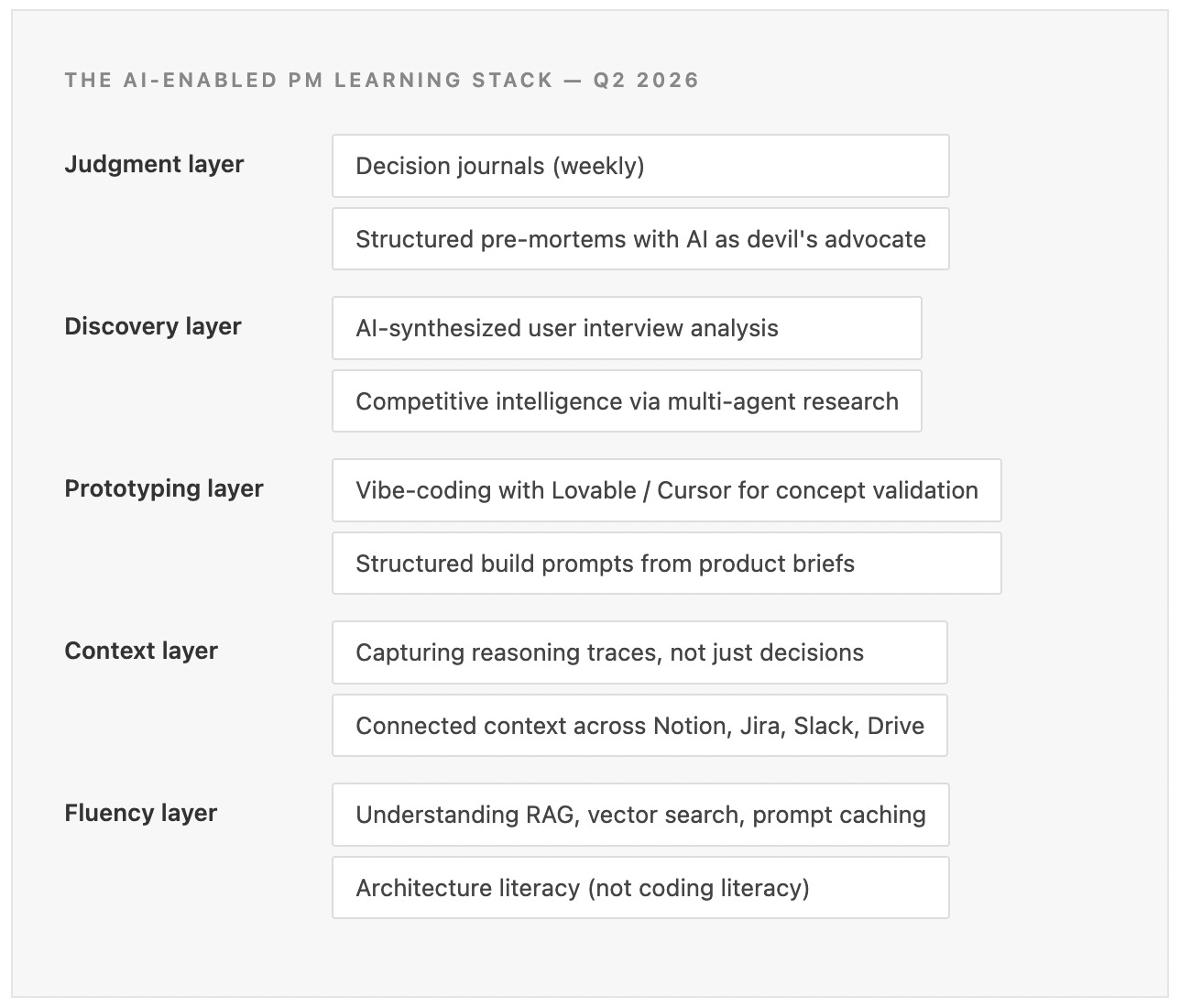
Notice what’s missing: there’s no “take this AI course” entry. Courses will teach you about AI. Using AI on real product decisions teaches you with AI. The best upskilling happens inside your actual work, not adjacent to it.
Five Moves: Start here, this week
Run your next strategy discussion with AI as a challenger.Share your reasoning, ask it to steelman the opposing view, then document where it changed your thinking — and where it didn’t.
Write a decision log entry for your last big call.Not what you decided — why. What did you know? What were you uncertain about? What would have changed your answer? This is the muscle AI can’t build for you.
Build something with a vibe-coding tool in 90 minutes.Not to ship it. To understand what AI-assisted prototyping actually feels like — its speed, its gaps, and where human judgment still does the real work.
Read one piece of AI infrastructure writing per week.Prompt caching, context windows, retrieval-augmented generation. You don’t need to implement these. You need to know how they affect what your product can do.
Find one meeting you’re attending for visibility, not value.Replace it with async AI-synthesized updates. Use the reclaimed time for the judgment work that requires your brain, not your presence.
Signals This Week
Model routing is becoming a PM decision
Platforms like Cursor and Lovable now route different tasks to different models — fast models for autocomplete, reasoning models for complex generation. This is an architecture decision with product tradeoffs that PMs need to understand and weigh in on.
Pattern → AI tooling ecosystem
Prompt caching isn’t just a cost lever
Teams treating prompt caching purely as infrastructure optimization are missing that it fundamentally changes what’s feasible in product UX — longer context, faster responses, richer personalization. It’s an architecture constraint that unlocks product decisions.
Signal → AI infrastructure & product design
Agentic workflows are changing the PM–engineering contract
When agents can execute multi-step tasks autonomously, the scoping, sequencing, and error-recovery design moves from engineering into product thinking. PMs who don’t understand agentic failure modes will spec systems that break in production.
Trend → Multi-agent product design
“The PMs who thrive won’t be the ones who learned the most AI tools. They’ll be the ones who used AI to make sharper decisions — and built the habit of capturing why, not just what. That’s the compounding advantage. That’s the moat.”
The AI-Enabled PM