Should You Build or Buy Your Next AI Capability?
A practical guide for Product Managers to cut through the noise and make the right call for their product.
TL;DR: Building AI in-house gives you control and long-term differentiation, but it’s expensive and slow. Buying accelerates deployment and taps mature tech, but creates integration and dependency risks. Most teams end up hybrid - build the core, buy the commodity, and orchestrate both.
What’s really at stake (for PMs)
This isn’t a binary decision. It’s a strategy fit problem - match your approach to your goals, culture, structure, and constraints.
- Build fits companies chasing long-term differentiation and control. This usually means deep integration into your product architecture - custom models, data pipelines, and infra woven tightly into your systems. High investment, but high alignment.
- Buy fits teams that need quick scalability and access to advanced capabilities. You move fast, but you still face integration work - connecting vendor APIs, aligning data flows, and ensuring the external tech fits your UX, reliability, and compliance needs.
- Hybrid balances agility (buy) with innovation (build). You buy for immediate impact, while building the pieces where deep integration creates a moat.
Real-world playbooks
Build (moat first): Tesla
Built its own FSD chips, Dojo supercomputer, and custom vision stack. This is deep architectural integration - autonomy is inseparable from Tesla’s hardware and software. High R&D costs, but unmatched control.
Buy (speed first): Microsoft
Acquired Nuance and partnered with OpenAI to add best-in-class speech and generative AI. Buying gave them immediate capability, but the hard part was integration into Azure and Office without breaking user experience.
Hybrid (balance first): IBM & Adobe
Built Watson (IBM) and Sensei (Adobe), but also acquired complementary players like Red Hat and Figma. Hybrid success came from deliberately integrating in-house platforms with bought components
Pattern:
- Build when AI defines the product.
- Buy when AI enhances the product.
- Hybrid when scaling across multiple workflows.
A PM-friendly framework: decide in minutes, not months
1) Decision guardrails (ask these four)
- Is this capability core to how we win?
→ If Yes, lean to Build (or Hybrid if time-boxed). - Do we have unique data/workflows that improve outcomes?
→ If Yes, lean Build/Hybrid to exploit proprietary advantage. - Is the business need urgent (time-to-market trumps uniqueness)?
→ If Yes, lean Buy for immediate impact. - Will integration/compliance demands be heavy?
→ If Heavy, favor Build/Hybrid for control over pipelines, governance, and SLAs.
2) The 7S lens (translate strategy to org reality)
The McKinsey 7S framework gives PMs a useful way to think about Build vs Buy decisions:
- Strategy - Build = long-term differentiation; Buy = rapid scale; Hybrid = balance.
- Structure - Build = centralized R&D and AI labs; Buy = decentralized business units integrating acquisitions; Hybrid = integrated cross-functional setup.
- Systems - Build = proprietary frameworks, MLOps pipelines, and in-house infra; Buy = vendor APIs, acquired platforms stitched in; Hybrid = orchestrate both.
- Style - Build thrives in innovation-first cultures that celebrate experimentation; Buy fits efficiency-driven, results-oriented cultures; Hybrid demands adaptability.
- Staff - Build requires specialized in-house researchers/engineers; Buy leverages acquired teams and integration specialists; Hybrid mixes both.
- Skills - Build = deep technical ML/AI expertise; Buy = strong vendor management and integration skills; Hybrid = systems thinking and cross-disciplinary capability.
- Shared values - Build cultures prioritize independence and control (e.g., Tesla, Google). Buy cultures emphasize speed, partnerships, and market responsiveness (e.g., Microsoft). Hybrid cultures value flexibility, pragmatism, and a “best tool for the job” mindset (e.g., IBM, Adobe).
PM insight - If your org looks like a “Buy” culture but you push a “Build” strategy, expect friction. Align your AI plan to org realities.
3) The staged path most teams take
Pilot with Buy → Prove value → Internalize the core → Settle in Hybrid.
In practice, Hybrid becomes the steady-state for many enterprises:
- Build the foundational or highly differentiating layers.
- Buy the specialized or commodity pieces.
- Integrate deliberately so you can swap or expand without breaking the system.
PM insight - Don’t frame Build vs Buy as a one-off decision. Treat it as a phased strategy you revisit as usage, cost, and compliance change.
Decision aid: build-buy scorecard
Here’s a simple scorecard you can adapt to guide Build vs Buy discussions with execs and engineering.
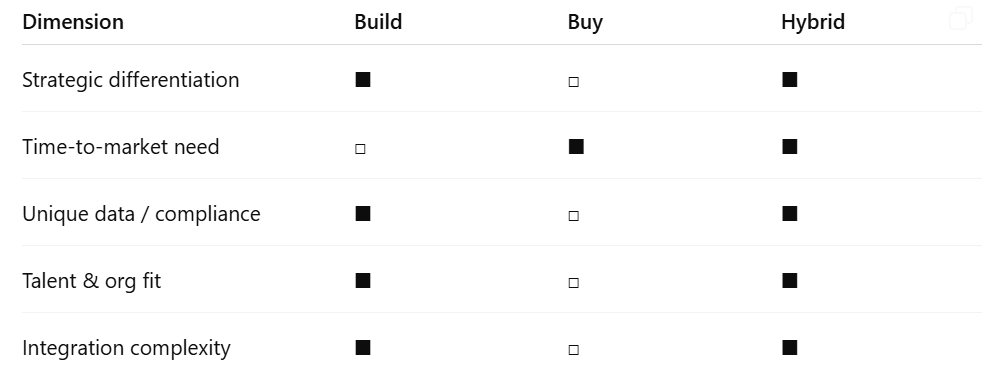
Using build-buy scorecard
- Assign your own weights based on company context.
- A startup may weight time-to-market highest; an enterprise in a regulated space may emphasize compliance and integration.
- Tally your scores to make trade-offs explicit.
Quick hits & closing thought
- Build = moat. Invest when AI is your differentiator, not just a feature.
- Buy = speed. Use when time-to-market outweighs uniqueness.
- Hybrid = reality. Most companies end up here — design for it.
- Stage it. Pilot with Buy → Prove → Internalize → Hybrid.
- Keep escape hatches. Abstraction layers make future switches cheaper.
There’s no single “right” play. The best PMs adapt - aligning strategy with their org’s reality, and evolving as needs change.